
Analyze the composition of stone veneer patterns.
2026-09-22
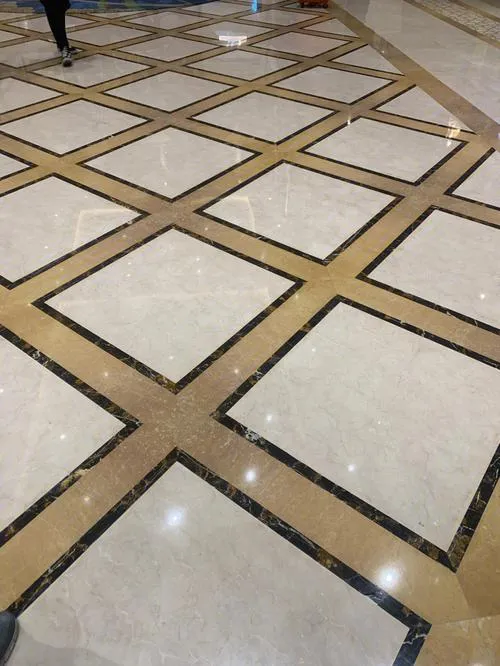
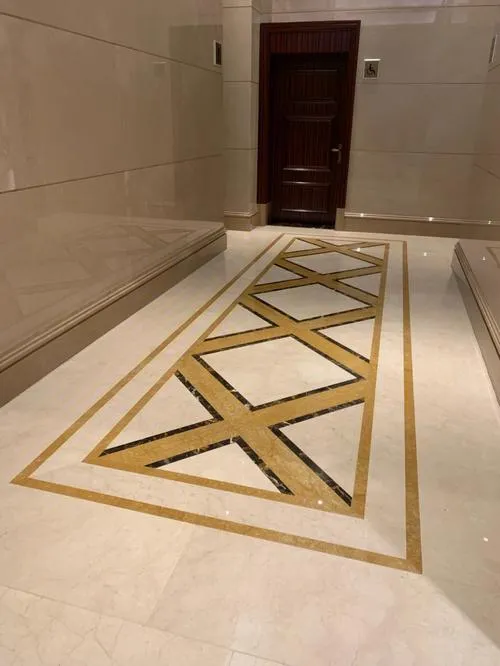
Stone medallions perfectly showcase the charm of natural stone. But how should stone medallion patterns be designed? Below are eight methods for forming stone medallion patterns.
1. Continuous Patterns
One or two basic shapes are combined to form a unit pattern. A pattern repeated horizontally or vertically is defined as a two-way continuous pattern, while one repeatedly arranged in all directions in an orderly manner is termed a four-way continuous pattern. Variations within the pattern shall cater to diverse requirements and deliver a sense of fluidity.
2. Alternating Patterns
Regular grid frameworks and shapes are adopted to create variations such as alternating, repeating, interspersing, symmetry and pattern transformation, following mutation rules including "one concealed and one visible", "one large and one small", "one long and one short", or "one wide and one narrow".
3. Natural-form Patterns
Decorative patterns composed of irregular series of straight geometric shapes, curved forms, and the directional characteristics of their veining.
4. Radiating Patterns
Developed from gradient patterns, radiating patterns take selected coloured dots or blocks as centres and extend outward orderly in linear or curved forms in all directions. Such patterns can feature one or multiple central points, floating points, prominent or subtle focal points. Main styles include radial, centrifugal, centripetal, spiral (equiangular and involute), sinusoidal, and dot-contrast types. Radiating patterns deliver a striking decorative effect, creating a visual impression of glowing light.
5. Flat "Three-dimensional" Patterns
This technique projects three-dimensional forms onto a two-dimensional plane to create a perceived "three-dimensional" spatial effect. Common approaches include linear-curved spatial arrangement, folded-line relief arrangement, focal perspective, illusionary multi-focal perspective, colour contrast, shape overlapping, and bas-relief rendering. Spatial perception can also be generated through adjustments in area size, orientation, shape gradation, radiation and density. This method delivers unique visual appeal and achieves more vivid modelling results.
6. Gradient Patterns
Natural stone features highly complex colour variations, with infinite changes to the dots, lines and planes of its veining. Slab surfaces commonly display veining that appears and fades, brightens and darkens; colour dots fluctuate in size; vein lines vary freely in length, shape, width and density, with textures shifting from dark to light and low to high brightness. Gradient patterns are formed by regularly arranging and cyclically repeating line, shape, size and colour gradients, alongside brightness contrast techniques. They are further categorised into linear, curved and diagonal gradients. This abstract expression maximises decorative performance, generates rhythmicity, and offers versatile artistic expression and innovative potential.
7. Density-based Clustering Patterns
Some stone materials, particularly marble slabs, feature uneven distribution and varying density of colour and veining. For such slabs, density contrast can be used to create free-form surfaces unrestricted by primary veining or pattern units, forming a visual focal point via clustering composition.
Dot clustering is a common approach: one or multiple dots serve as dense focal centres, with sparse arrangements around them to build contrast and visual unity. A second approach is line clustering: vein lines form dense visual anchors on the base surface, supplemented by density contrast of other basic graphic forms to build patterns composed of clustered shapes and lines.
8. Mutation Patterns
Abrupt colour shifts and sudden veining changes in stone have long been regarded as troublesome defects — designers often face the dilemma that such features are unusable yet too valuable to discard. From an aesthetic and artistic perspective, designers need to conceive graphics creatively and adopt additive composition methods. Dramatic shape mutations can break the monotony of large cladding surfaces, introduce novelty, and enhance the artistic value of the original stone finish.