
CNC System for Special-shaped Stone Processing
2026-08-17
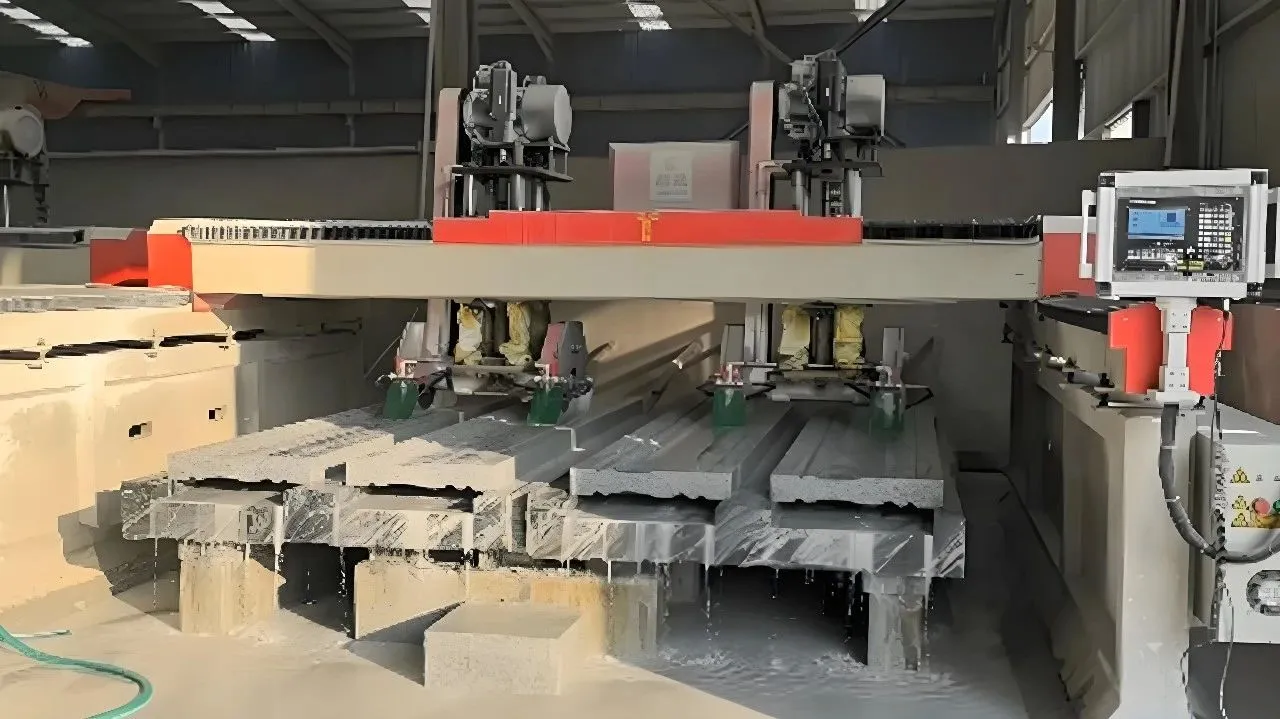
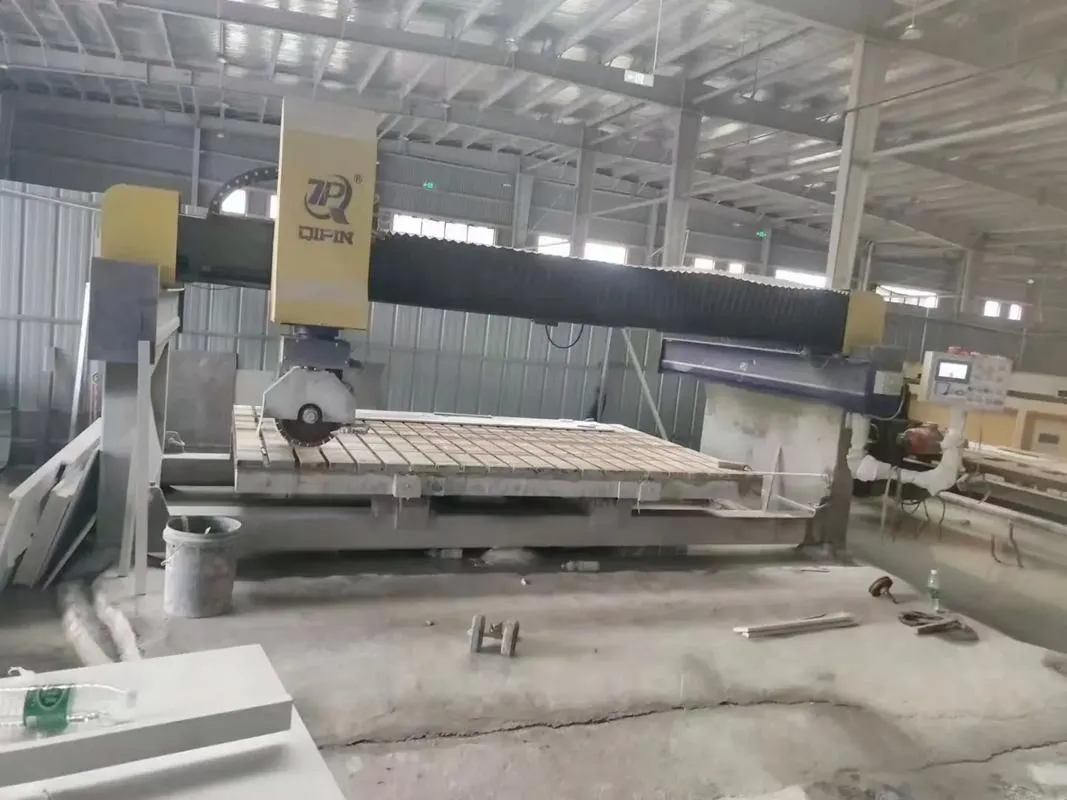
The multi‑function CNC machining center is used to machine a wide range of stone three‑dimensional special‑shaped products including portrait carvings, column carvings, irregular column capitals and column bases; flat reliefs, bathroom basins, bathtubs and vanity tops, kitchen countertop slabs, straight and curved decorative mouldings, curved‑edge slab and other flat profiled workpieces, as well as finish‑milling, thickness‑setting, grinding and polishing of arc‑shaped slabs. The finished products may feature symmetrical, asymmetrical or irregular outlines and forms.
Structurally, this type of machine integrates the functions of several conventional CNC processing machines into one single unit. Additional machine functions can be achieved by installing optional accessories. A CNC machining center equipped with only one cylindrical milling spindle generally requires five‑axis control: the machine must control rotational angular positioning of the workpiece, horizontal (X‑axis), vertical (Z‑axis) and longitudinal (Y‑axis) travel and positioning of the cylindrical milling cutter, together with tilting‑angle control of the cutter spindle itself. This represents the minimum number of controlled axes required for statue‑type workpiece machining. Currently up to six‑axis control is available, governing six directions of motion: workpiece rotation speed and rotational angular positioning, left‑right (X‑axis), vertical (Z‑axis) and front‑rear (Y‑axis) travel and positioning of the cylindrical milling cutter, plus two tilting motions of the cutter spindle: side‑to‑side swing angle and forward tilt angle.
CNC lathes are mainly used to machine rotary‑body components, rotary‑body carved parts and three‑dimensional carved stonework. Spindle speed adjustment adapts the machine to stone materials of different composition and hardness, as well as workpieces of varying diameters. Rotational angle positioning meets the machining requirements of statues and carved columns. Non‑rotary workpieces are mounted on the worktable; combined with cutters moving along X, Y and Z axes, the machine performs the machining functions of a CNC milling machine. Swinging of the cutter axis (the cylindrical milling cutter can swing within the range of 0 to ±45° or ±90°) enables machining of workpiece side faces. Synchronized movement of the cutter along the X, Y and Z axes constitutes the fundamental motion for profiling irregular shapes.
To boost machining efficiency and produce more complex special‑shaped components, an additional sawing spindle fitted with a circular saw blade should be added to perform saw‑cutting operations, which is also indispensable for machining twisted‑fluted columns. This saw spindle may be mounted on the same carriage as the cylindrical‑milling spindle, with controlled travel along the X, Y and Z axes. If the saw blade can rotate about the vertical axis of its diameter (360‑degree rotation of the saw‑blade plane) with controlled angular positioning, the blade can perform cutting in all directions. A machining center with six‑axis control of this kind forms the basic configuration of a multi‑function CNC stone machining center.
To raise the automation level and production efficiency of multi‑axis CNC machining, the machine is also fitted with a tool magazine holding 10‑25 cutters, which automatically exchanges tools during processing as required. Machining flat profiled products such as bathroom vanity tops and kitchen countertop slabs requires a minimum set of nine tools: two diamond cylindrical end‑mills for cutting outer contours, two diamond form cutters for profiling curved edges, four curved‑edge grinding and polishing wheels and one rough‑cutting saw blade for slab openings. If surface grinding and polishing of the slab face is also required, two additional diamond thickness‑setting cutters and four extra grinding‑polishing wheels must be added. Operators may select the appropriate tool‑magazine capacity according to their actual product range. For example, when processing the above‑mentioned items using pre‑polished slabs, at least six tools can be omitted, naturally reducing machine cost; nevertheless, all tools essential for the machining process cannot be dispensed with. For the six‑axis CNC machining center described above, a tool magazine with 12‑16 tools is recommended.
With regard to the control system, multi‑axis CNC machining centers generate workpiece‑machining programs mainly by two approaches: graphic programming and model scanning. For simple, regular and symmetrical products, two‑dimensional and three‑dimensional geometric models of the target workpiece are created in CAD geometric‑modelling software, and the relevant dimensions of the geometric model are defined using selected size and shape parameters. For highly complex three‑dimensional carved workpieces such as portrait sculptures, CAD‑based geometric modelling and programming is extremely labor‑intensive and time‑consuming. To simplify workflow and improve productivity, laser scanning can be used to scan a pre‑fabricated small physical model; the CNC system then converts the scanned data into a CAD graphical program, thereby improving both programming efficiency and accuracy. Fully‑featured, multi‑axis CNC machining centers are generally equipped with a laser scanning device in addition to the graphic‑design software module.